
How to Actually Build a Wellness Routine as a Mom (That Does Not Take 2 Hours)

Wellness culture has a mom problem. It sells a vision of health that requires two free hours every morning, access to an expensive gym, a meal prep routine that takes an entire Sunday, and the kind of mental bandwidth that evaporates when you have children and a career and a household to run.
Real wellness for real mothers looks different. It is not about doing more. It is about doing the right things, consistently, in the windows you actually have. Here is how to build it.

Redefining what wellness looks like with kids
Wellness is not a destination. It is not a state you achieve after completing a 30-day program. For mothers, wellness is the practice of consistently tending to your physical, mental, and emotional needs inside the constraints of real life. Some days that looks like a morning workout and a meditation. Most days it looks like drinking enough water and going to bed on time.
The version of wellness that actually sticks is the one you can maintain when things go wrong. Not the ideal version. The floor version.
The minimum effective dose of self care
Borrowed from pharmacology, the minimum effective dose is the smallest amount of something that produces a meaningful result. Applied to self care, it is the question: what is the least I can do that still makes a real difference?
For most moms, the answer is sleep, movement, and one thing that is entirely for you. Not all three perfectly. Just those three things, at whatever dose is currently possible. Build from there.
Morning, midday, and evening rituals that take under 10 minutes each
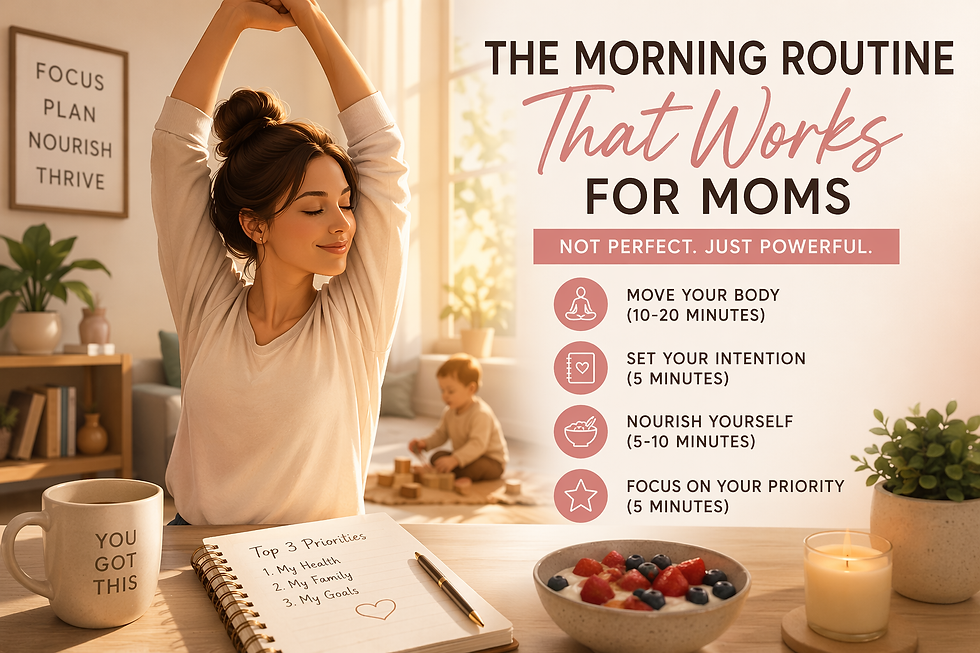
Morning: drink a full glass of water before coffee. Step outside or near a window for 5 minutes of natural light. Write down one thing you want to accomplish today. Total time: under 8 minutes.
Midday: take a genuine 10-minute break from work, away from a screen. Eat something, even if it is small. Breathe. This sounds trivial. For a mom who usually eats standing over the kitchen sink, it is not.
Evening: put your phone away 30 minutes before bed. Take five slow breaths before you sleep. Let tomorrow's problems wait until tomorrow. These micro-rituals signal to your nervous system that the day is over and rest is allowed.
How to make movement a daily habit without a gym
Attach movement to something you already do. A 10-minute walk after drop-off. Stretching while your coffee brews. Bodyweight exercises during the first five minutes of your lunch break. Movement integrated into existing moments builds faster than movement scheduled into a separate time block that then gets canceled.
Sleep as a wellness non-negotiable
No wellness routine compensates for chronic sleep deprivation. Sleep is where your brain consolidates memory, your immune system repairs damage, your hormones reset, and your nervous system recovers from the day. Sacrificing sleep to fit in your wellness routine is counterproductive.
If you have a choice between an extra 30 minutes of sleep and an extra 30 minutes of journaling, choose sleep. Almost always.
Protecting your mental health as part of your routine
Mental health is not a separate category from physical wellness. It is foundational to it. A consistent practice that supports your mental health, whether that is therapy, journaling, time in nature, creative expression, or simply talking to a friend who truly gets it, is not a luxury. It is maintenance.
You do not have to earn rest. You do not have to justify taking care of yourself. You are allowed to be well. That is the first thing to believe, and everything else builds from there.


Comments